Mauki – a machine for eliminating rodents, voles and moles
1 490.00 Kč/day with VAT 1 231.40 Kč excluding VAT
Mauki works on the principle of fumigation (gasification) with carbon monoxide in combination with carbon dioxide, in accordance with Czech laws on animal cruelty. This makes it an approved professional machine that can be used to eliminate not only rodents and voles, but also moles that cause damage.
Refundable deposit: CZK 10,000
Rental price with service: 1,400 CZK incl. VAT / hour
Rental price without service: 1,490 CZK incl. VAT / day
For an individual service offer, please contact us.
Terms and conditions for renting machines and tools here.
Daily prize: Mauki – a machine for eliminating rodents, voles and moles
1 490.00 Kč/ day
There are many so-called "guaranteed methods" against the occurrence of moles, shrews and voles. It is certainly ecological to seek protection from them in their natural enemies, to apply mechanical methods (nets around the root systems), to plant bait plants (with the aim of concentrating them in other places), to implement alternative methods (hair, fur of predatory animals) or to use aromatic substances (walnut leaves, elderberry, or garlic and onion cloves), acoustic and electronic devices. Or even less ecological and often illegal trapping, laying poisoned baits and implementing other often dangerous and at the same time comical methods for humans, such as the elimination of moles, shrews and voles by fumigation with explosive propane butane. The fumigation itself is not as dangerous as its subsequent ignition. No one, except the pest itself, knows exactly where the corridors lead, how deep they are and where they end. It is up to everyone whether they want to invest money and time in one of the above "guaranteed methods" without any significant effect, or entrust the elimination of these pests to the reliable, professional and very effective Mauki machine.
Mauki works on the principle of fumigation (gasification) with carbon monoxide in combination with carbon dioxide, in accordance with Czech laws on animal cruelty. This makes it an approved professional machine that can be used to eliminate not only rodents and voles, but also moles that cause damage.
Carbon monoxide is not only poisonous to pests, but also to humans. Therefore, only a trained person may work with the Mauki machine, following the safety regulations specified in the instruction manual, which is included with each machine.
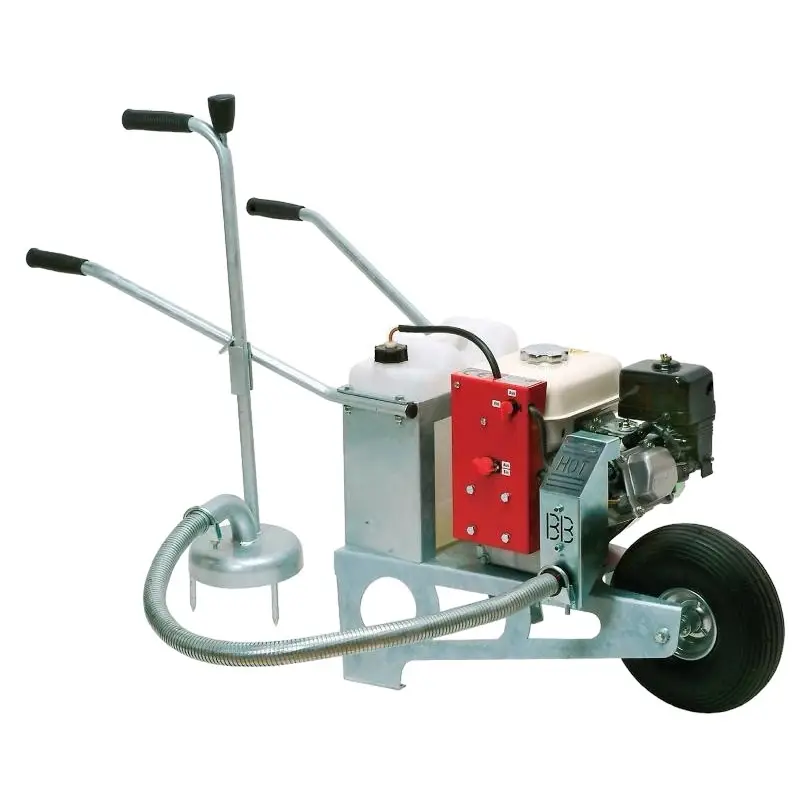
Carbon monoxide is injected into the excavated passages using the high exhaust pressure of a powerful Honda combustion engine, mounted on a robust galvanized chassis similar to a wheelbarrow. The pump draws in a mixture of gasoline and diesel from an additional 10-liter tank and injects the fuel mixture by precise dosing in a special exhaust silencer. The fuel evaporates very quickly and the resulting mixture of gases (carbon monoxide and carbon dioxide in the form of white smoke) is guided through a flexible metal hose, which ends with a wide bell on three fixing pins that prevent it from collapsing or bouncing off after being placed at the mouth of an exposed passage (when moving the bell to other already prepared entrances to burrows, it is always necessary to turn off the gas generation). The powerful Mauki engine develops such a high pressure that this mixture of poisonous gases displaces the oxygen in the passage system. This instantly paralyzes the lungs of the pests, leading to their very quick and painless death. Killed or stunned rodents, voles or moles remain mostly in their burrows, but if they are found and caught by a predator, there is no further risk of secondary infestation.
For 100% effect, the entire corridor system must be affected, and this is achieved by injecting the poisonous gas in multiple locations. In practice, this means that every 10 meters the gas must be injected for at least 10 minutes.
In sloping terrain, it is necessary to work from top to bottom, on flat terrain, the surroundings are cleared and then the work is continued in a circular manner towards the center.
The machine includes a probe rod with a ball-shaped reinforcement at the end for a larger exit hole. Thanks to this, you can safely identify whether there is a burrow for shrews, moles or voles at the injection site, and the white smoke escaping will reveal when this location is also filled with gas.
Pest resolution:
| Water flea | Field vole | Common mole | |
| Appearance | Body length 13-17cm
Tail length 8-12cm Coat reddish brown – brownish gray |
Body length 9-12cm
Tail length 4cm Coat brown, dark gray |
Body length 13-17cm
Tail length 3cm Coat gray-black – gray-brown |
| Corridors | Oval in height
4-6 cm wide 6-8 cm high Without plant roots Just a few side corridors |
Round, diameter 3-4cm
Frequent above-ground trails Branched with open holes |
Slightly oval in width
5-6cm wide 4-5cm high There are plant roots in the corridors Numerous branching side corridors, many are blind |
| Length of corridors | 25 meters | The corridor systems are interconnected | 100 meters and more |
| Outlet hole | Bitten plants near the holes
They are clogged within 6 hours after opening |
A large number of holes,
they have crushed remains of leaves and stems |
There are no gnawed plants near the holes
After the corridor opens, it is often left open for several days |
| Piles of soil | Elongated, flat
Outside the mouth of the corridor Left or right of the hallway Lumpy structure |
Scattered soil at the entrances | Large, circular,
evenly piled up from the mouth of the corridor Above the main hallway Finer soil structure |
| Soil heaving under snow | Direct course
Length several meters There are plant parts in the soil |
Corridors immediately under the snow | Various shapes, forked branches
Soil without plants and roots |
| Living space | Wet soils, ditches, banks
streams, slopes, meadows, deciduous and mixed forests, gardens, orchards, vineyards |
Semi-humid to dry grasslands,
deciduous forests, gardens and parks |
Semi-humid to dry grasslands,
deciduous forests, gardens and parks |
| Food | Herbivore – plant roots,
trees, vegetables |
Green parts of plants, seeds,
roots |
Insectivore – worms, insects,
larvae, pupae and snails |
| Reproduction | 3-5 litters per year
after 5 chicks |
10-15 litters per year
after 4-8 chicks |
1-2 litters
after 3-5 chicks |
| Disposal | Mauki – a mixture of carbon dioxide and carbon monoxide without restrictions | Mauki – a mixture of carbon dioxide and carbon monoxide without restrictions | Mauki – a mixture of carbon dioxide and carbon monoxide only in case of damage |
| Weight | 3500 kg |
|---|